Custom AI automation for warehouses, 3PLs and product brands, built on your real systems.
Lui does the admin inside the systems you already run. Custom work is for when you want more than a chat can give you: a customer portal, a public order page, a board that follows every job, a workflow or a report built around your business, by the team that makes Lui, on your real data. One call, one page, one price.
Three builds below, each on a real customer's real systems. Blakeley Designs, a wholesale brand in Houston, went from two weeks of launch invoicing to ten minutes with Lui before the portal was built.
What is custom AI automation?
Custom AI automation is a workflow, a screen or a report built for one business on the systems it already runs, with an assistant doing the reading, the typing and the checking inside those systems instead of a person. It is not a chatbot bolted on the side and not a new system to migrate to: the warehouse system, the shop, the accounting and the mailbox stay in charge, and the build works in them through their own APIs.
At LogisticsUI the assistant is Lui, the systems are the ones on the integrations page, and the custom work is done by the people who build Lui, inside your own account, so what we build keeps the chat, the alerts and the permissions you already have.
Three things we built for customers, on their real systems.
Each one has its own page with the screens, what it replaced, and what changed.
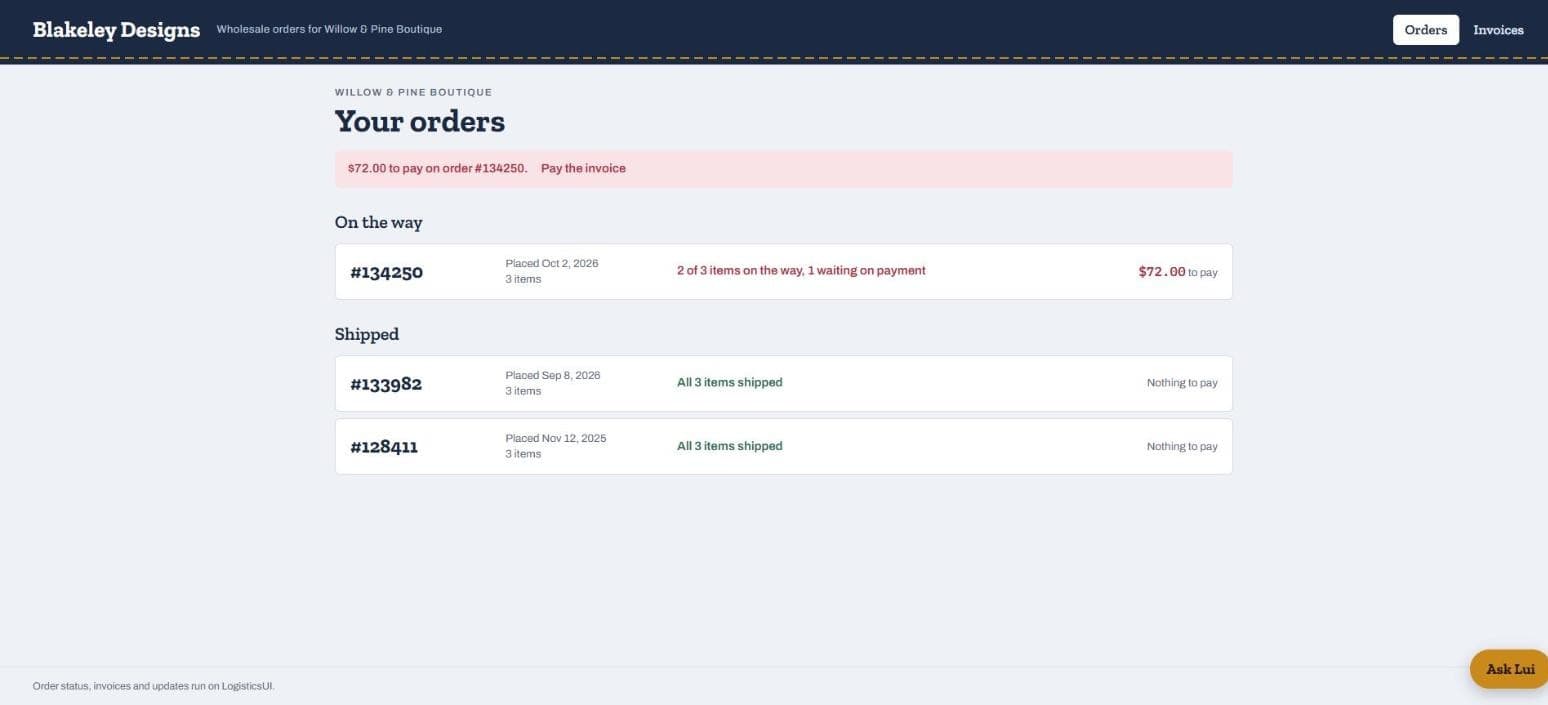 Customer portal · wholesale brandBoutiques stopped asking why their order has not shipped, because the portal tells them.Built for Blakeley Designs, a wholesale clothing brand, on their order, supplier, warehouse and invoice data. The screens below are the same portal running on invented boutiques.Shopify

 Read the case study →
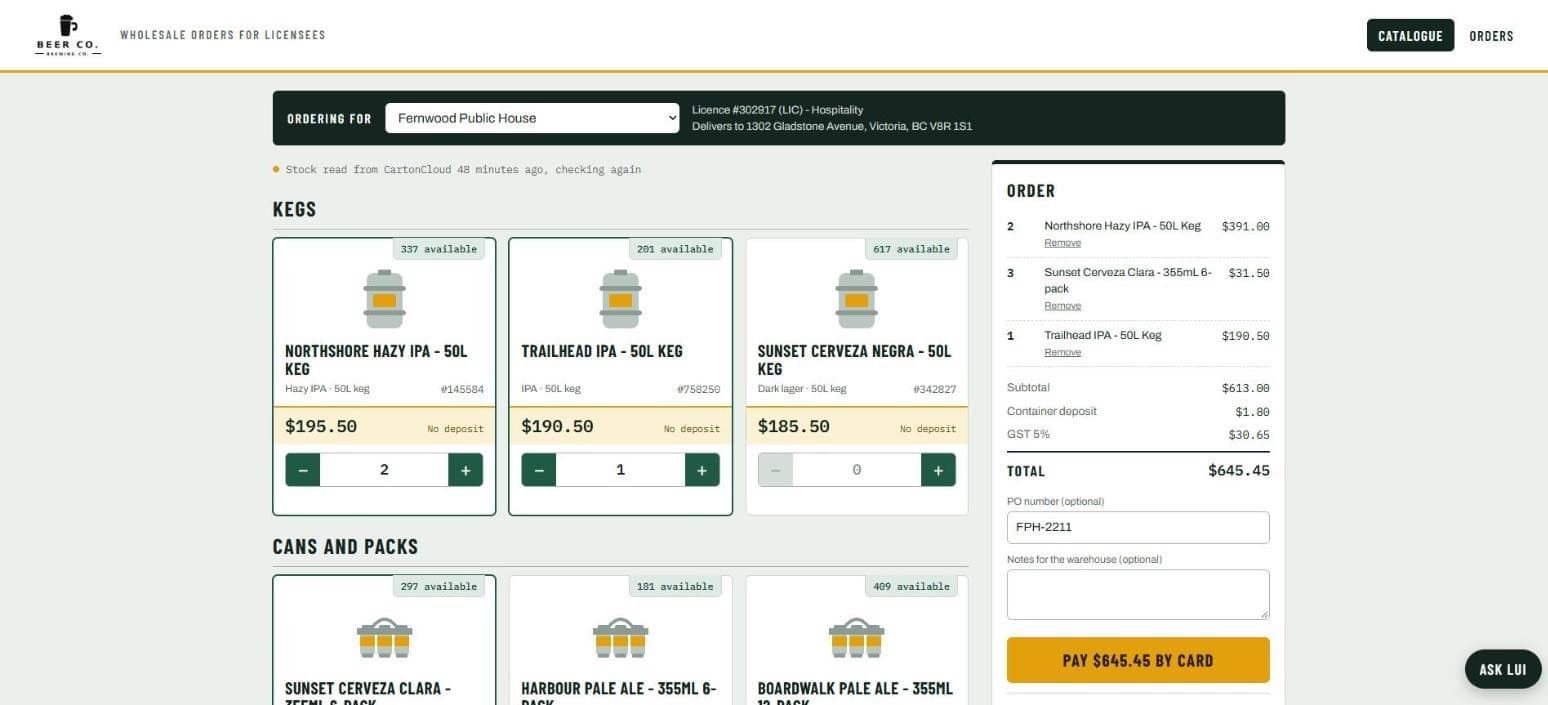 Public order page · beer and wine distributorLicensees order online against live stock, pay by card, and the Doc 60 writes itself.Built for a beer and wine distributor in BC, against their warehouse system; the first store under their name. Shown here on the demo store, Beer Co., with invented licensees.Read the case study →
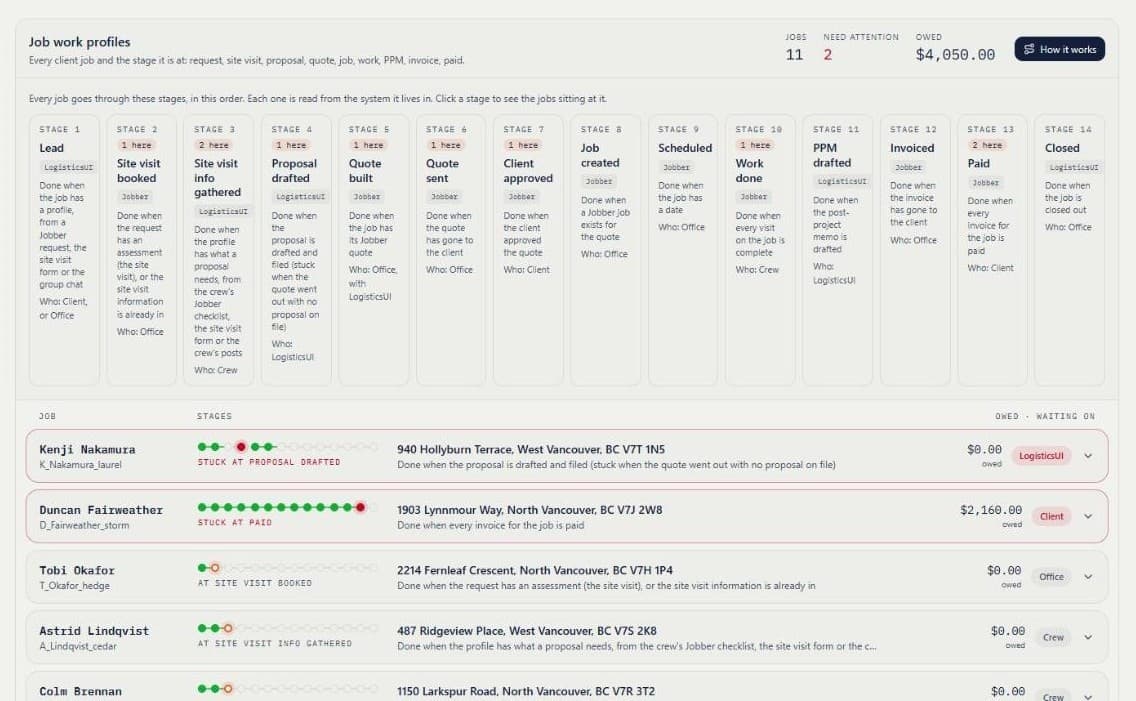 Work profile · service businessEveryone can see where every job is, without asking three people.In daily use at a Jobber-run tree-care company in North Vancouver since October 2026. The screens below are the real board running on invented jobs.
 WhatsApp
 Google DriveRead the case study →
Want one like these on your own systems?
The shapes custom work takes.
A customer portal
A link your customers open to see every line of their order, where it is, and pay the invoice.
A public order page
Your catalogue with live stock under your name; the order is created once, after the payment.
A board that follows the job
One record per job or order across its stages, each stage proved by a fact read from where it lives.
A scheduled report or reconciliation
The weekly check, the month-end match across two systems, the exception list, run on a clock and sent.
An invoicing or billing workflow
Launch invoicing from the orders, payment chasing, the release of held stock. Month-end billing from your own rate card needs no build: ask Lui for it.
Documents on your templates
The pick sheet, the shipping document, the quote, the Doc 60, filled from the order on your own Word template.
Three steps, and the first one is a conversation.
A call about the job
You describe the work the way you would brief a new hire. We say what Lui already does, what needs building, and roughly what it would cost.
A scope and a price
One page: what gets built, what it runs on, what done looks like, the number. Fixed per project. No retainer, no hourly surprises.
Built with you, on your data
We build it inside your LogisticsUI account, against your real systems, with you looking at it as it comes together. Weeks, not quarters.
The build lives where your data already is.
It runs inside the account you already have
No new login, no new server, no handoff to a team that has never seen your data. The build sits beside the chat and the alerts, on the systems you connected on Settings, with the same permissions.
The assistant that answers questions is the one that runs the build
Lui reads the same orders, stock, invoices and jobs the build does. Ask it where a job is or why an order held, and it answers from the record the build maintains.
The integrations are already done
CartonCloud, Shopify, ShipStation, QuickBooks, Jobber, Gmail, Outlook, Slack, Amazon Seller and the rest are connected systems, not a line item on a quote. The build starts at the workflow, not at the API.
You keep it after we leave
What we build is yours to run: the standing jobs keep running, the chat keeps answering, and the usage is billed the same way as everything else on your account.
Questions about custom work
What does custom work cost?
A fixed price per project, quoted after the call. The usage it runs on afterwards is billed the same way as everything else on your account. There is no retainer.
Is this an AI automation agency?
It is the team that builds Lui, building for your business on the systems Lui already connects to. The difference from an agency is that the integrations exist before the first call, and what we build lives in your account rather than on the agency's servers.
Do I need a LogisticsUI account?
Yes. Custom work runs inside your account, beside the chat, the alerts and the connected systems, so it uses the same data and the same permissions. The account is free to start.
What kinds of things have you built?
A customer portal, a public order page with live stock and card payment, a board that follows a job through fourteen stages, launch invoicing, storage billing from a rate card, reorders from what sold, documents on a customer's own template. The three case studies on this page are the shape of it.
Can you set up the whole thing and run it for us?
Yes. Connecting your systems, loading your rules and building your first jobs with you is a service, and running the standing jobs afterwards is what Lui does.
How long does it take?
A portal or a storefront is weeks. A board, a report or a billing workflow is often days. The scope says the date, and the first version is on your real data, not a mock-up.
What if we already use ChatGPT or Claude?
Keep using them for the work a person does at a keyboard. Custom work is for the jobs that have to run on their own, on your systems: the same approved steps every time, a check before anything runs, and a stop with the reason when something fails. The comparison page sets the three side by side. Lui vs ChatGPT, Claude and Gemini →