Bill every client from your own rate card, without the month-end spreadsheet.
Upload your rate card or describe it. On the first of the month Lui prices each client's month from your warehouse system and what the floor logged, puts the invoices in QuickBooks for you to approve, and tells you who pays late.
Fun Do Run Logistics, a 3PL in California, has one upload create the orders and fill in their rate card sheet in the same pass.
Works with QuickBooks Online · $20 of usage free · no card
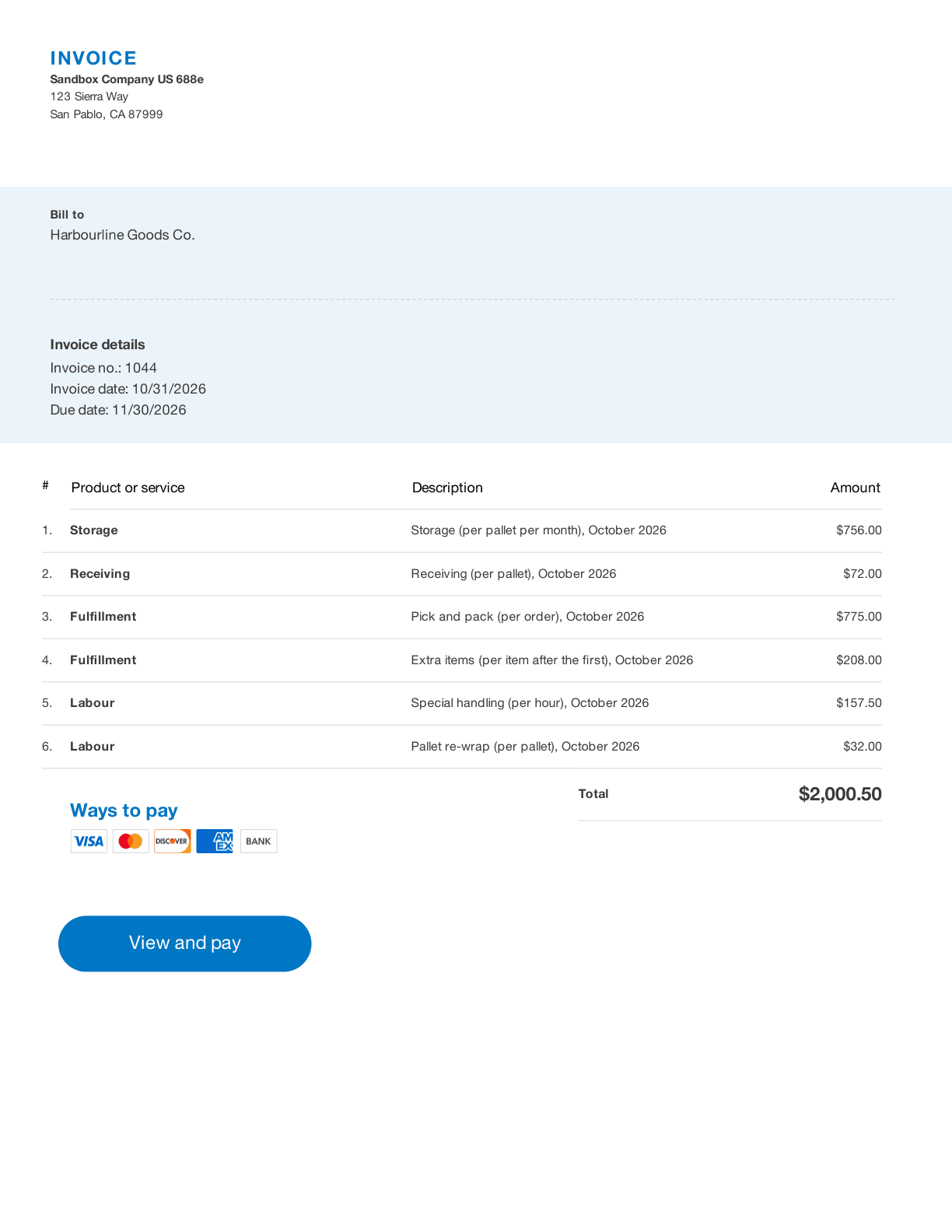
One invented client's month, priced from the sample rate card and created in a QuickBooks test company, the same way Lui does yours.
Open the PDFWhat is 3PL billing?
3PL billing is how a third-party warehouse charges each client for the month's work: storage by the pallet, bin or square foot, for a month, half a month or a day; receiving; pick and pack; and the extras, like labour hours, re-wraps and labels. What each client pays for each of those is its rate card.
In most small 3PLs it happens at month end in a spreadsheet. Someone exports the warehouse system's activity, adds what the floor wrote down, prices each line from the rate card and types each invoice into QuickBooks. It comes back every month, and the work the floor logged on paper is the first thing to go unbilled.
Lui does that month for you. It keeps your rate card, counts each client's month from the warehouse system and the floor's log, and puts the invoices in QuickBooks for you to approve.
One client's month, priced from its rate card.
Every line on the invoice is a rate from the rate card times a count from the month. Lui shows you this before anything goes into QuickBooks.
| Charge | Rate | This month | Counted from | Billed |
|---|---|---|---|---|
| Storage | $18.00 a pallet a month | 42 pallets on hand on the 1st | The warehouse system | $756.00 |
| Receiving | $6.00 a pallet | 12 pallets received | The warehouse system | $72.00 |
| Pick and pack | $2.50 an order | 310 orders shipped | The warehouse system | $775.00 |
| Extra items | $0.40 an item after the first | 520 items | The warehouse system | $208.00 |
| Special handling | $45.00 an hour | 3.5 hours | The floor's form | $157.50 |
| Pallet re-wrap | $8.00 a pallet | 4 pallets | The floor's form | $32.00 |
| Total | $2,000.50 |
An invented client and invented numbers; the arithmetic is real. The sample invoice at the top of the page has the same six lines.
Three ways 3PLs bill their clients now.
The month-end spreadsheet
Export the activity, add the floor's notes, price every line, type every invoice. It comes back every month, and the notes on paper are the first thing missed.
The warehouse system's billing
It bills the charges it records, once the rates are set up inside it. The special handling the floor wrote down, or a rate kept in a spreadsheet, still ends up on the spreadsheet.
A separate billing system
One more place to keep the rates, the clients and the activity in step with the warehouse system and the accounting, and one more thing to set up before the first invoice.
Your rate card, billed every month, the same way.
Whatever your rate card says, Lui bills it, and you set it up by asking.
Lui already invoices at volume: Blakeley Designs, a wholesale brand in Houston, invoices a pre-order launch of several hundred orders in about ten minutes. By hand it took two weeks.
- Any rate card, in your wordsPer pallet, per order, per hour. Half-month storage, a monthly minimum, one client's own deal. Upload the spreadsheet or say it, and change a rate in one sentence.
- Every charge billedOrders shipped, inbounds received and pallets on hand come from Lui's copy of your warehouse system. The work the floor logs on a form, hours of special handling and re-wraps, is counted beside it, so nothing done goes unbilled.
- You approve every invoiceEach client's invoice is created in QuickBooks and held until you look. Nothing is emailed until you say so, and then QuickBooks sends it.
- Late payers, flagged every morningLui checks QuickBooks each morning for invoices past their due date and tells you which, so chasing starts the day one is late.
- Keep your warehouse systemNothing to switch and no billing module to set up. On a warehouse system Lui doesn't connect to yet, drop in its export.
Three steps, and the first month is a dry run.
Send Lui your rate card
Upload the spreadsheet, start from our template, or type the charges. Lui reads it back as a table, one row per charge, for you to correct.
Price last month
From your warehouse system once it's connected, or from an export you drop in. Lui shows each client's invoice lines and total, and nothing goes into QuickBooks until you say.
Make it monthly
Say "bill everyone on the first of the month" and "tell me every morning who is overdue". The invoices wait in QuickBooks for your yes.
No rate card in a spreadsheet yet? Start from ours.
A 3PL rate card template with the usual charges filled in as examples: storage, receiving, pick and pack, extra items, special handling, re-wraps and a monthly minimum. Put in your rates, then upload it to Lui.
Questions people ask before they start
What is 3PL billing?
How a third-party warehouse charges each client for the month: storage, receiving, pick and pack, and extras like labour and re-wraps, each priced from that client's rate card and sent as an invoice.
What goes on a 3PL rate card?
Usually receiving (per pallet, carton or container), storage (per pallet, bin or square foot, for a month or part of one), pick and pack (per order and per extra item), packaging, returns, labour by the hour, value-added work like labelling and kitting, and often a monthly minimum. The free template above has the common lines to start from.
How is 3PL storage billed?
Per pallet, bin or square foot, for a period: a calendar month, half a month, a month from the day the stock arrived, or by the day. Tell Lui which one your rate card uses and it counts storage that way.
My warehouse system already does billing. Why use Lui?
If its rate cards cover everything you charge, keep using them. Lui is for the rest: a rate card that lives in a spreadsheet, work logged outside the warehouse system, a client's own deal, and the chasing after the invoice goes out.
We're not on CartonCloud. Does it work?
Yes. Lui reads the month from the warehouse systems it connects to, and from an export of any other. The columns don't need to match anything; it asks if one is unclear. For CartonCloud →
Which accounting systems does it work with?
QuickBooks Online, and Hiveage. The invoices are created there, in your own books, and sent from there. QuickBooks →
Will it send invoices without me?
No. Each invoice is created in QuickBooks and held until you approve it. Only then does QuickBooks email it to the client.
Can it handle minimums, tiers and one client's special rates?
Yes. Say it the way you would to a new hire, "Acme pays $2.25 a pick, everyone else $2.50", "picks over 1,000 a month are $2.00" or "a $500 minimum a month", and it goes into the rate card. Every invoice line is priced from the rate card.
Do I need the template?
No. Upload the rate card you have, in whatever layout it's in, or type the charges. The template is there if you're starting from nothing.
What does it cost?
$20 of usage comes with the account, no card. After that you pay for the work Lui does, from a balance you top up, or take a monthly plan from $99. Pricing →
Also:For CartonCloudQuickBooksAlerts and workflowsInvoicing and reordersSkills