Skip to content
Reporting

Ask what shipped last month and get the answer.

Lui answers questions about orders, stock and dispatch from your own data, across your warehouse system, your store and your spreadsheets, and shows what it used. Senderoo's inventory planning across 100 SKUs took two people a week. Now it takes one person a day.

Blakeley Designs' reorder used to be two or three hours in a spreadsheet. Now it is a question answered in minutes, from a phone.

CartonCloud · Shopify · Google Sheets · whatever lands in the warehouse

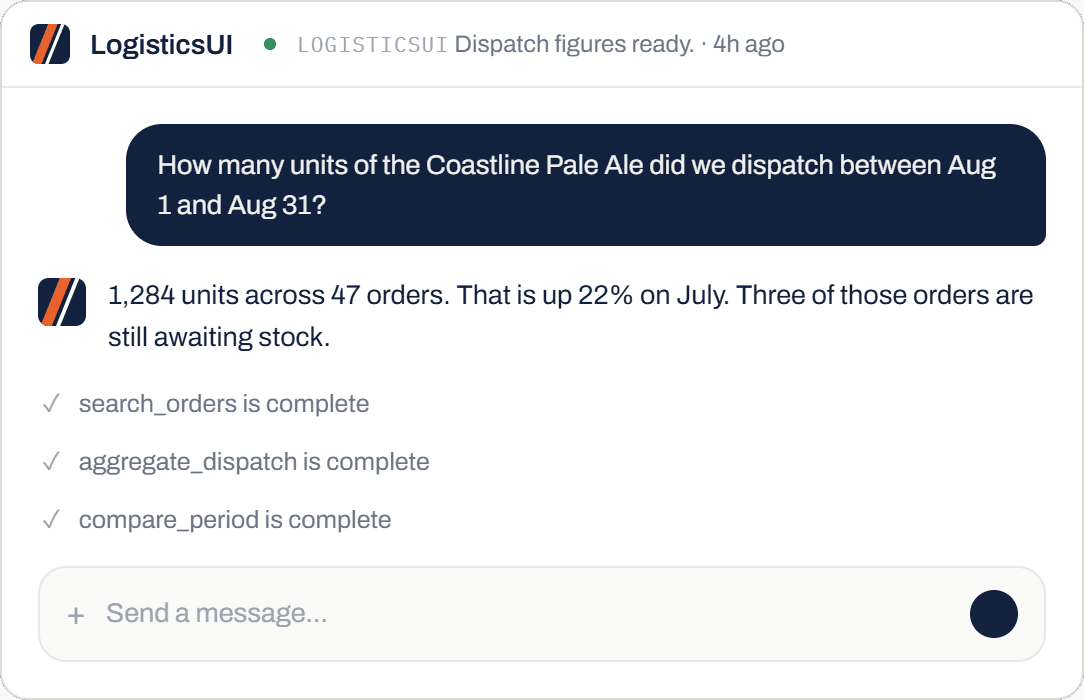
The LogisticsUI chat answering a dispatch question: units shipped in a date range, order count, and the change on the previous month.
Products and volumes are examples, not real client data.
The short answer

What does 3PL reporting look like without a report builder?

A 3PL report usually means four exports, a spreadsheet, and a formula somebody half trusts, because the question sits across systems that do not talk: the warehouse system, the store, a marketplace, a wholesale channel.

Lui answers the question directly. It reads the warehouse system, the store, and anything that lands in the warehouse from another channel, does the arithmetic, and says what it based the number on. What happened is its strength. What to reorder it grounds in your sales history. A forecast it gives as a starting point, with the reasoning attached so you can argue with it.

What Lui answers

Four kinds of question, one sentence back.

"how many shipped in March?"

Dispatch and stock questions

How many of a product went out between two dates. What is on hand. What is awaiting stock and why. No report builder, no date pickers.

4 channels · no integration

Planning without an integration

Everything that lands in the warehouse system can be asked about, whichever channel it came from: Amazon, Faire, Shopify, wholesale. That is what turned a week of planning into a day. For CartonCloud →

"what should I reorder?"

Reorder recommendations from history

Ask what to reorder based on the sizes and colours that actually sold. Lui comes back with the winners, the dead stock, and the products you are not reordering but should be. Invoicing and reorders →

emailed every Monday

Reports on a schedule

Any question you ask once can become a standing report: same question, same time every week, in your inbox. Alerts and workflows →

How it works

Three steps, from the question to the answer.

  1. Connect the system the answer lives in

    Your warehouse system, your store, or a spreadsheet. Once, from Settings, with the steps beside each one.

  2. Ask in plain words

    "How many units of this shipped in March, and how does that compare with February?" Lui answers and shows the numbers it used.

  3. Make it a standing report

    Say "every Monday at 7am" and the same question arrives in your inbox every week, answered.

Worth knowing

What it is and is not good at.

It is very good at questions about what happened. It is careful about questions about what will happen.

  • What happened: strongDispatch volumes, stock positions, averages, period comparisons. It is reading your own data and showing its working.
  • What to reorder: goodGrounded in your sales history and your buffer. It tells you what it based the number on.
  • Forecasting: a starting pointA projection from last year's swing is a real input, not a promise. It gives the number and the reasoning so you can argue with it.
  • ExportAny answer can come out as a sheet or an email if you would rather work with it elsewhere.
A customer

How Blakeley Designs uses it

Blakeley Designs

Wholesale clothing brand, Houston, Texas

A Shopify brand selling pre-orders to hundreds of boutiques. Lui invoices a launch, chases the unpaid invoices, frees held stock, and tells the owner what to reorder from what actually sold. Built with them as skills; see the case study.

  • Two weeks10 minutesinvoicing a pre-order launch of several hundred orders
  • Two or three hours in a spreadsheetMinutes, from a phonethe reorder: which sizes and colours to order again, from what sold
  • Held for weeks behind unpaid ordersBack on sale the same daystock reserved against invoices that were never going to be paid
“It's helped me 1000%. I would never want to go backward.”
Blakeley Designs
“You already have winners but you're not reordering them. Based on past sales you didn't sell a lot of this colour. There was no way to ask that before.”
Blakeley Designs
“Tried so many apps. Didn't quite do what I wanted. One even lost us money by messing up the orders.”
Blakeley Designs
FAQ

Questions people ask before they start

Which systems can it report across?

Anything connected. Today that is CartonCloud, Shopify, ShipStation, QuickBooks, Jobber, Hiveage and Google Sheets, plus anything that arrives into the warehouse from another channel.

Does every channel need to be connected?

No, and this is the useful part. If orders from a marketplace land in your warehouse system, Lui can answer about them even though the marketplace itself was never connected.

Can I export the answer?

Yes. Any answer can be written to a sheet or emailed, and the same question can be set to run on a schedule.

How accurate is a forecast?

It is arithmetic on your own history, not a black box. Lui shows what it used: last year's swing, this year's volume, your buffer. So you can judge it.

Can it email the report weekly?

Yes. Ask the question once, then say you want it every Monday at 7am. It becomes a standing report. Alerts and workflows →

Also:For CartonCloudInvoicing and reordersReorderingAlerts and workflowsAI for 3PL warehouses

Get started

Bring the report you never have time to pull.

The one you would build if the day had two more hours in it. Create your account, connect the system, and ask. The first $20 of usage is free.

Ask my first question

Google or an email address. $20 of usage free, no card.

Or have it built and run for you: custom work, at a fixed price per project.