What AI can actually do in a small 3PL right now
Most writing about AI for 3PL warehouses is about enterprise robotics or a chat widget on a website. This is about the admin: the copy-paste, the reports, the SKU sheets, in an operation of ten to fifty people. Four warehouses and brands use it every day.
Four clients · live today · $249/mo to start
Missing SKUs, some orders 40 lines long. A whole morning of typing, done in about ten minutes.
Planning across Amazon, Faire, Shopify and the WMS took two people a week. Most of it was never integrated. Now it is one question.
A standing check she built herself, the morning after the feature shipped. Nobody asked her to.
Six things, each one a real client job
Every item here is something a customer does with it now, not a roadmap.
Turn documents into orders
Packing slips, emailed POs and spreadsheet exports become orders in the WMS. It works for the customers who were never going to integrate, which is most of the small ones. Order entry →
Fix what the integration rejected
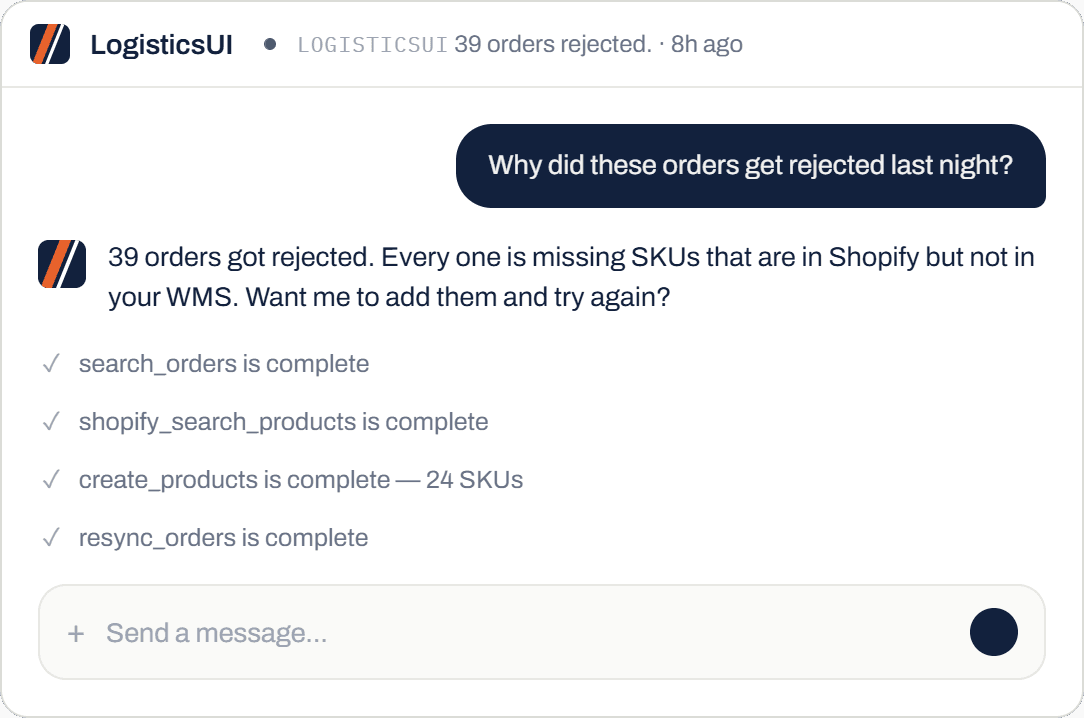
Orders bounce because a SKU is in the store but not the warehouse. It finds them, creates them and resyncs. Then it became a Monday check so the orders stop rejecting at all. Alerts & workflows →
Answer questions across systems
Inventory planning across Amazon, Faire, Shopify and CartonCloud, with no integration for most of it. Two people for a week became one person for a day. Reporting →
Run standing workflows
Invoicing after a launch. Overdue invoices cancelled so stock is freed. Supplier orders drafted and emailed. You describe it once and it runs. Invoicing & reorders →
Produce compliance documents
Doc 60 for BC liquor shipments, built from the order and the pricing on the sheet rather than typed out again. Doc 60 →
Learn your rules
No expiry dates on this customer. Case quantities, not units. This brand ships from Kelowna. Said once in the chat, applied from then on.
What it does not do
The useful version of this technology has clear edges. Here are ours.
The last one matters most. Every automatic action is written to a log you can read: what ran, when, and what it changed. That is the difference between something you trust and something you supervise.
- It does not replace your WMSCartonCloud, or whatever you run, stays the source of truth. This sits on top and does the typing.
- It does not move boxesNo robotics, no slotting algorithms, no forklift. This is the admin around the physical work.
- It does not act outside your rulesIt does what you have told it to do. Anything it is unsure about comes back to you as a question.
- It shows its workEvery action it took is on the board, one line per run. You can click any of them and ask what happened.
It starts smaller than you think
One 3PL started over Christmas with basic sales orders because it was the busiest week and there was no time to train anyone. That was the whole first use.
Nobody ran a project. Each step happened because the last one worked and something else was annoying that week.
- Week oneSales orders from documents, during the Christmas rush.
- ThenStock checks. What have we got, where is it, what is awaiting stock.
- ThenPurchase orders, and planning across channels that were never integrated.
- Then, unpromptedShe built her own weekly alert the morning after the feature shipped. Her words: "I worry I'm not using it enough."
Against what the admin costs you now
The comparison that matters is not against other software. It is against the hours.
Core
Orders and reports moving on their own between a system or two. You ask for things when you need them.
Pro
Standing workflows. Daily checks between your WMS and your store, rejected orders caught and fixed, supplier orders running on their own.
Onboarding
From $1,000 to hook up your systems, load your rules and build your first jobs with you. Paid once, not monthly.
It's like your personal assistant. It's doing stuff an assistant can't do.
Senderoo, 3PL warehouse
Questions we get asked
Is my data used to train anything?
No. We keep a working copy of what your systems tell us so questions come back fast, and the files you upload. It is not used to train any model.
What happens when it gets something wrong?
You see it, because every action is logged. Most mistakes early on are missing rules. It did not know you count in cases. You tell it once and it does not happen again.
Do I need technical staff?
No. We connect your systems during setup. After that your team types what they want in plain words. If they can send a text, they can use it.
Which WMS does it work with?
CartonCloud is live and is where most of our customers are. Any WMS with an API or webhooks can be connected as part of setup. For CartonCloud →
How long does setup take?
Days, not months. Connecting the systems is the quick part. The useful time goes into loading your rules and building your first standing jobs with you.
See it on your own operation
Bring the job you would hand to a new admin hire. We will run it live and you can judge whether it is real.